

In many cases, yes. When a motorcycle accident with a truck in Louisiana takes a rider's life, family members may bring a wrongful death claim and a survival action against the at-fault driver. The filing deadline is generally two years for deaths on or after July 1, 2024, and the rider's share of fault can shrink or bar recovery.
These crashes happen on Louisiana roads. In one example, Louisiana State Police reported a fatal crash between a motorcycle and a pickup truck on LA 308 in Raceland, according to WWL-TV. This article does not discuss that crash or anyone involved in it. Instead, it explains what families in situations like this generally need to know.
What is the short answer for families after a fatal motorcycle and truck crash?
Families generally have a path to compensation, but it has limits. Louisiana law allows two kinds of claims after a death, sets a deadline to file, and reduces or bars recovery based on fault. Insurance limits also shape what may be paid.
Every crash is different. The answer depends on who caused the wreck, which insurance policies apply, who the rider left behind, and when the crash happened. The crash date matters more than ever, because two big rule changes took effect for crashes on or after January 1, 2026.
This article walks through each piece in plain words. It is general information, not legal advice. For advice about a specific crash, talk with a licensed Louisiana lawyer.
What usually happens in motorcycle and pickup truck crashes on roads like LA 308?

Most of these crashes follow a few familiar patterns. A truck turns left across a rider's path, a driver doesn't see the bike, or a vehicle follows too closely and can't stop in time. Two-lane state highways with many driveways and side roads can make each of these more likely.
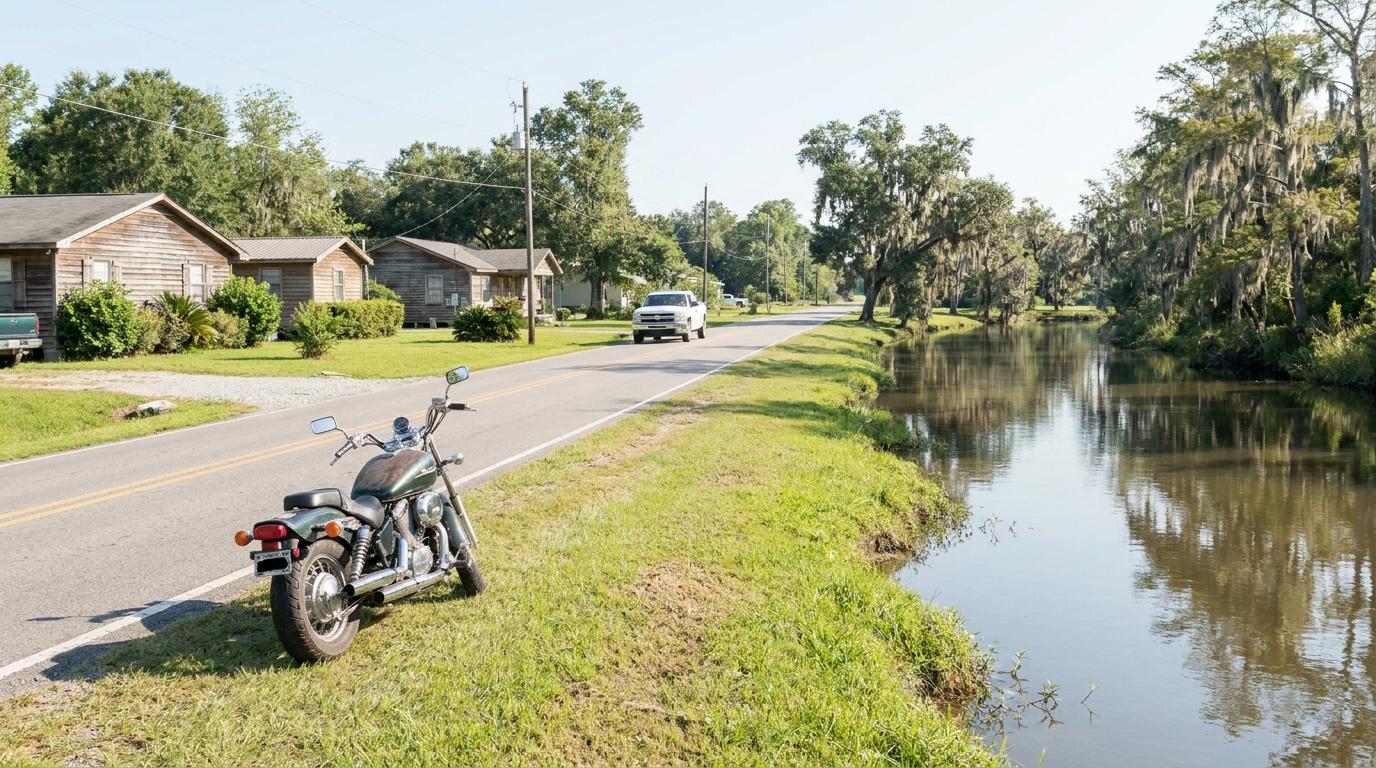
LA 308 is one example of this kind of road. It runs along Bayou Lafourche through Lafourche Parish, with homes, businesses, side streets and driveways close together. Pickups, work trucks and everyday traffic share the same two lanes with motorcycles.
Here are the patterns that come up again and again:
- Left turns across the rider's path. A pickup turning into a driveway or side road may cut in front of an oncoming motorcycle. Louisiana law, La. R.S. 32:122, generally requires a driver turning left to yield to oncoming traffic that is close enough to be a hazard.
- Visibility problems. A motorcycle is narrow and easy to miss. It can hide behind a mirror, a roof pillar or a larger vehicle, and glare can make it harder to judge its speed.
- Following too closely. A pickup behind a motorcycle may not stop in time if the rider slows for a turn. La. R.S. 32:81 says drivers should not follow more closely than is reasonable and prudent.
- Pulling out from driveways and side roads. A driver checking for cars may look right past a bike and pull into its path.
- Passing on two-lane roads. A truck passing slower traffic may move into a lane where a rider is coming the other way.
The federal safety agency NHTSA urges drivers to watch for motorcycles and give riders room. Its motorcycle safety information also stresses how exposed riders are compared with people inside cars and trucks. In a crash with a heavy pickup, a rider has almost no protection.
How does Louisiana law look at a wrongful death claim after a motorcycle accident?
Louisiana treats a fatal crash as creating two separate claims. A survival action covers the losses the rider suffered before death. A wrongful death claim covers the family's own losses from the death. Both are usually brought together against the at-fault driver and the insurers.
The starting point is Louisiana Civil Code Article 2315, which says a person who causes harm through fault must repair it. The survival action comes from Civil Code Article 2315.1, and the wrongful death claim comes from Article 2315.2. You can read the text of these laws on the Louisiana State Legislature's website.
The two claims cover different losses:
| Survival action (Art. 2315.1) | Wrongful death claim (Art. 2315.2) | |
|---|---|---|
| Whose losses? | The rider's own losses before death | The family's losses caused by the death |
| Examples | Pain and suffering before death, medical bills, lost wages before death | Loss of love and companionship, loss of financial support, loss of guidance |
| Who brings it? | Family members in the order set by law | Family members in the order set by law |
Not every relative can file. Louisiana law sets an order, and only the highest group with a living member may bring the claims:
- 01. The surviving spouse and children.
- 02. If there are none, the surviving parents.
- 03. If there are none, the surviving brothers and sisters.
- 04. If there are none, the surviving grandparents.
This order can feel unfair to families who were close in other ways. For example, a fiancé or a longtime partner who was not married to the rider generally is not on the list. Family situations like stepchildren, adoptions or children born outside a marriage can raise their own questions, which a lawyer can look at.
How long do families have to file a claim in Louisiana?
For deaths and injuries on or after July 1, 2024, the deadline to file is generally two years. Older cases generally fall under the former one-year rule. Missing the deadline can end a claim no matter how strong the facts are.
Louisiana calls this deadline prescription, which is the state's word for a filing deadline. The two-year rule comes from Civil Code Article 3493.1, added by Act 423 of 2024. Before that change, most injury and death claims had to be filed within one year.
The change only looks forward. A crash or death before July 1, 2024 is generally still under the one-year rule. For a wrongful death claim, the clock usually starts on the date of death, which may be later than the crash date if the rider survived for a time.
Exceptions to these deadlines are narrow. Talking with insurance adjusters or trading paperwork does not usually pause the clock. That is why it helps to learn the exact deadline for each claim early, rather than waiting until the funeral and first weeks have passed.
How does fault work, and what changed on January 1, 2026?
Louisiana splits fault by percentage among everyone who caused a crash. For crashes before January 1, 2026, a family's award is generally reduced by the rider's share of fault. For crashes on or after that date, a rider found 51% or more at fault generally means the family recovers nothing.
This system is called comparative fault, and it comes from Civil Code Article 2323. Under the older rule, a rider found 70% at fault could still recover 30% of the damages. That was often called pure comparative fault.
 Do I Have A Case?Answer a few quick questions about your accident.Check My Case
Act 15 of 2025 changed this for crashes on or after January 1, 2026. Now, the 51% line can decide whether a family recovers anything at all. A few simple examples show how it generally works:
- Rider 0% at fault: the award is not reduced for fault.
- Rider 30% at fault: the award is generally reduced by 30%.
- Rider 50% at fault: the award is generally reduced by half.
- Rider 51% or more at fault: the family generally recovers nothing.
This is why insurers often look hard for ways to blame the rider. They may point to speed, lane position, lack of a helmet, or riding at dusk. Louisiana requires riders to wear helmets under La. R.S. 32:190, and an insurer may argue that a missing helmet should count against a claim. How much weight that carries depends on the facts and the medical evidence.
Another 2025 change also matters. Act 466 of 2025 limits recovery of past medical expenses to amounts actually paid, rather than the full amount billed, starting January 1, 2026. Which crash dates and which claims this covers can depend on the details, so families should ask a lawyer how it applies to their case.
Where does insurance money come from after a motorcycle and truck crash?
Payment usually comes from insurance, not from the driver's own pocket. The main sources are the truck driver's liability policy, an employer's commercial policy if the driver was working, and the rider's own uninsured or underinsured motorist coverage. Each policy has limits that can cap what is paid.
Louisiana requires vehicle owners to carry liability insurance under La. R.S. 32:861. The trouble is that many drivers carry only low limits. In a fatal crash, those limits can run out quickly.
That makes other sources important. If the pickup was being used for work, the employer and its commercial policy may be part of the claim. A commercial policy is insurance a business buys for its vehicles, and its limits are often higher than a personal auto policy.
The rider's own policy may also help. Uninsured/underinsured motorist coverage, often called UM, can pay when the at-fault driver has no insurance or not enough. Louisiana's UM law is found at La. R.S. 22:1295. Check the rider's own motorcycle and car policies for UM coverage, since some households carry it on more than one vehicle.
If you have questions about how an insurance company is handling a claim, the Louisiana Department of Insurance offers consumer information and a way to file complaints about insurers.
What should families do, step by step?

Start by protecting the evidence and the deadline. Get the crash report, keep every record, report the claim to the right insurers, and avoid recorded statements until you understand your rights. These steps keep options open while your family grieves.
Here is a simple order to follow:
- 01. Get the crash report. Louisiana State Police or the local agency that worked the crash will prepare a report. Ask how to request a copy.
- 02. Write down what you know. Note the date, time, road, direction of travel and any witnesses' names. Memories fade fast.
- 03. Save photos and videos. Keep any pictures of the scene, the motorcycle, the truck and the road. Ask nearby businesses about cameras quickly, since footage is often erased.
- 04. Keep the motorcycle as it is. Don't let it be repaired, scrapped or sold until someone has had a chance to inspect it.
- 05. Gather records. Collect medical bills, the death certificate, funeral bills, pay stubs and tax returns. These help show the losses.
- 06. Find every insurance policy. Look for the rider's motorcycle policy, any household car policies and any UM coverage.
- 07. Mark the deadline. Write down the crash date and date of death, and learn the filing deadline that applies.
You don't have to do all of this in one week. But the first few weeks are when evidence like video and the vehicles is most at risk.
What mistakes can hurt a wrongful death claim?
The most common mistakes are missing the deadline, giving recorded statements too soon, signing releases early, and losing evidence. Posting about the crash online can also cause problems. Each of these can weaken a claim or end it entirely.
Watch out for these:
- Waiting too long. Grief takes time, but the filing deadline does not pause for it.
- Giving a recorded statement to the other driver's insurer. Adjusters may ask questions that later get used to shift fault onto the rider.
- Signing papers early. A release or quick settlement can end the family's rights for good. Read anything carefully before signing.
- Letting evidence disappear. Video gets erased, vehicles get scrapped and witnesses move away.
- Posting on social media. Comments about the crash, the rider's speed or riding habits can be taken out of context.
- Assuming the rider's fault ends the case. Even if the rider made a mistake, the other driver may share fault. The split matters, especially under the 51% rule.
Another common mix-up is thinking that only one family member can act. Under Louisiana law, the claims belong to the group set by law, such as a spouse and all of the children together. Family members working together usually makes the process smoother.
What are the next steps for your family?
The next step is getting clear answers about your own case. Learn the deadline that applies, find out which insurance policies may cover the loss, and understand how fault may be split. A lawyer can review these facts with you.
A fatal car wreck or auto accident involving a motorcycle and a truck leaves families with grief and a long list of questions. You don't have to answer them all at once. Start with the steps above, and keep your records in one safe place.
If you'd like to talk through what happened, Chris Corzo Injury Attorneys handles motorcycle crash and wrongful death cases across Louisiana, from Lafourche Parish to the rest of the state. Every case depends on its own facts, and no outcome can be promised.
To talk with Chris Corzo Injury Attorneys about a crash, reach out through the contact page on this website.
Frequently asked questions
Louisiana Civil Code Article 2315.2 sets an order of family members. The surviving spouse and children come first. If there are none, the parents may bring the claim, then brothers and sisters, then grandparents. Only the highest group with a living member can file. The same order generally applies to the survival action under Article 2315.1, which covers the rider's own losses before death.
Families generally have two years for deaths and injuries on or after July 1, 2024, under Civil Code Article 3493.1, added by Act 423 of 2024. Older cases generally fall under the former one-year rule. For wrongful death, the clock usually starts on the date of death. Exceptions are narrow, so learning the exact deadline early helps make sure it is not missed.
Recovery often depends on the rider's percentage of fault. For crashes before January 1, 2026, Louisiana's comparative fault rule generally reduces an award by the rider's share. For crashes on or after that date, Act 15 of 2025 bars recovery if the rider is found 51% or more at fault. Below that line, the award is generally reduced by the rider's share.
The vehicle type mostly changes the insurance picture, not the basic rules. A personal pickup is usually covered by the owner's auto policy. A pickup used for work may also be covered by an employer's commercial policy, which can add another source of payment. The same fault rules, filing deadlines and family claims under Louisiana law generally apply either way.
Sources