

Usually, more than one party may be liable when two 18-wheelers crash in Louisiana. Fault can fall on either truck driver, both trucking companies, a cargo loader, a maintenance shop or a parts maker. Louisiana generally splits blame by percentage, so each party may pay only its own share of the harm.
Who is liable when two 18-wheelers crash in Louisiana?
Liability usually follows the cause of the crash, not just who hit whom. If one driver was speeding or too tired, that driver and their employer may be liable. If bad brakes or a shifting load played a part, a repair shop or cargo loader may share the blame. Often, it is a mix of several causes.
Think of a truck crash as the end of a long chain of decisions. Someone hired the driver and set the schedule. Someone loaded the trailer, fixed the brakes and checked the tires. A weak link anywhere in that chain can lead to a crash.
That is why these cases tend to involve more parties than a typical car wreck. With two 18-wheelers, you may have two drivers, two trucking companies, two sets of cargo and two maintenance histories. Each one has to be looked at.
If you were driving nearby and got hurt, you generally do not have to figure out on your own which trucking company is more liable before you make a claim. Louisiana law has a way to divide the blame among everyone who caused the harm. Sorting out those shares is part of looking into the claim.
Here is a quick look at who may share fault and why:
| Who | How they may be at fault |
|---|---|
| Truck driver | Speeding, following too close, distracted or tired driving, unsafe lane changes |
| Trucking company | Unsafe schedules, poor hiring or training, skipped maintenance |
| Cargo loader or shipper | Overloading, uneven weight, cargo not tied down |
| Maintenance contractor | Poor brake, tire or lighting repairs |
| Parts maker | A defective part, such as a brake or tire that fails |
| Broker or other company | Depends on how much control it had over the trip, in some cases |
What usually happens after two 18-wheelers crash?
Usually, a crash between two 18-wheelers shuts down the road for hours. Police and fire crews secure the scene, heavy wreckers clear the trucks, and cleanup crews deal with fuel, oil or cargo. Meanwhile, insurers for the trucking companies often start working on their side of the case right away.
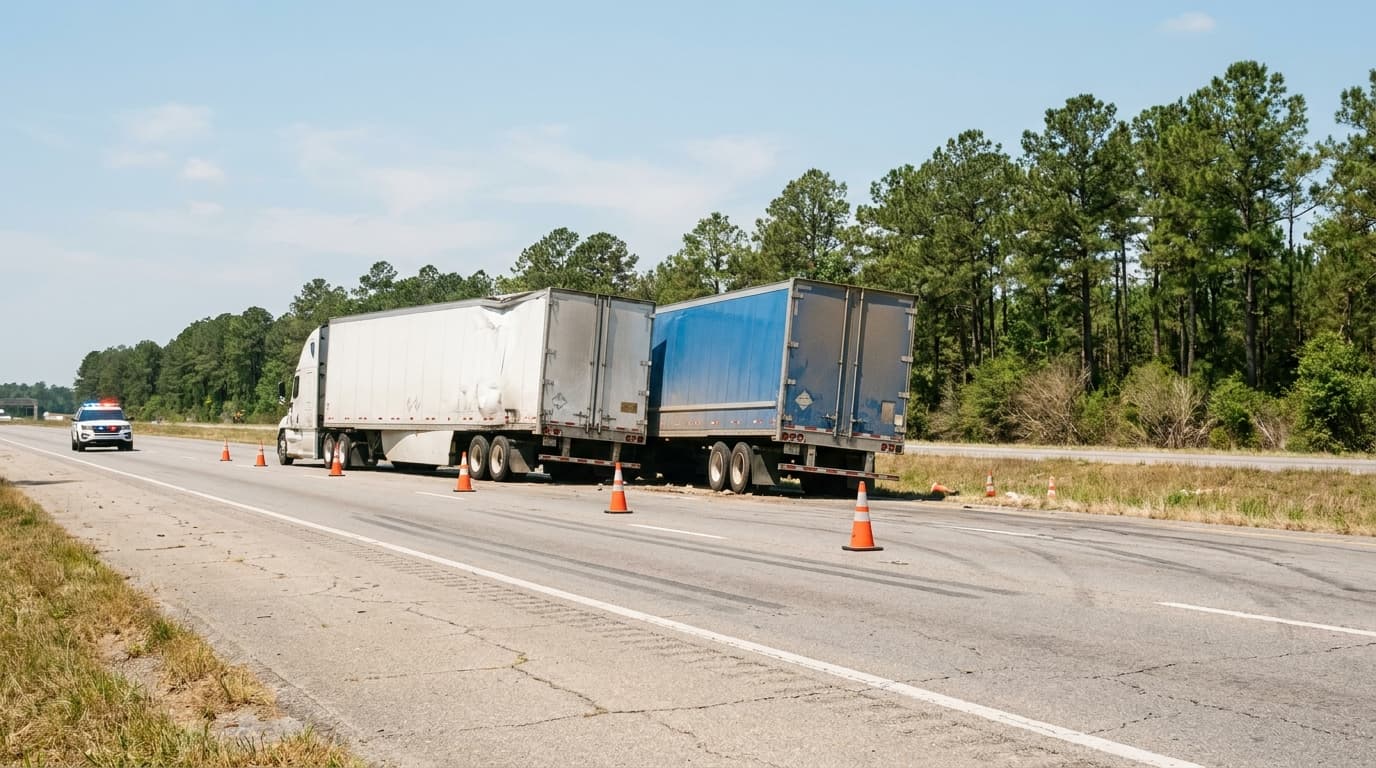
A real example shows how this can play out. In north Caddo Parish, two 18-wheelers collided on Interstate 49, and the interstate was closed. The sheriff's office reported that oil spilled on the road and that the Louisiana State Police hazardous materials office was alerted, according to the Shreveport-Bossier Advocate.
Scenes like this are not rare on Louisiana's freight routes. I-49, I-10, I-20 and I-12 all carry heavy truck traffic every day. When two loaded 18-wheelers crash, the damage often spreads well beyond the two cabs.
Drivers nearby can get pulled in fast. A car may be hit by flying debris or a jackknifed trailer. Others are hurt in a second wave, such as a rear-end auto accident in the line of stopped traffic.
Trucking companies may send a quick-response team after a serious crash. That team may include adjusters, investigators and lawyers who work for the carrier. Their job is to protect the company, not your claim.
How does Louisiana law look at fault in a truck crash?
Louisiana generally assigns fault by percentage. Under Civil Code Article 2323, each person who helped cause the harm gets a share of the blame, including you if you played a part. Your recovery is then generally reduced by your own share, and for newer crashes a large share can block recovery completely (see the 51% rule below).
Civil Code Article 2315 sets the basic rule that a person whose fault causes harm to another must repair it. A few more rules come up often in truck cases:
- Employer responsibility. Civil Code Article 2320 makes employers answerable for harm their workers cause while doing their jobs. So a trucking company is often liable for its driver's mistakes on the road.
- Separate shares. Under Civil Code Article 2324, each party at fault generally pays only its own share, not the whole bill. The main exception involves people who act together on purpose. That makes it important to find every party who may be liable.
- Federal safety rules. Interstate trucks must follow rules from the Federal Motor Carrier Safety Administration, including limits on driving hours and rules for inspections. Breaking these rules can be strong evidence of fault.
Louisiana's tort reform laws also changed some rules. Tort reform here means recent changes to the laws on injury claims. Which version applies depends on the date of your crash:
- 01. Filing deadline. Prescription (Louisiana's word for a filing deadline) is generally two years for injuries on or after July 1, 2024, under Civil Code Article 3493.1, added by Act 423 of 2024. For injuries before that date, the deadline was generally one year.
- 02. The 51% rule. Under Act 15 of 2025, effective January 1, 2026, a person found 51% or more at fault recovers nothing. This change generally applies to crashes on or after that date. Before it, a partly at-fault driver could still recover a reduced amount.
- 03. Past medical bills. Under Act 466 of 2025, effective January 1, 2026, past medical expenses are generally limited to amounts actually paid, not the full amount billed. Like the 51% rule, it generally applies going forward, not to older wrecks.
You can read the current text of these laws on the Louisiana State Legislature website. How they apply to you depends on the facts and the dates involved.
How does insurance work when two trucking companies are involved?
Each trucking company usually has its own commercial liability policy. With two 18-wheelers, you may deal with two or more insurers, and each may point at the other. Your own auto policy may also help while fault is sorted out.
Commercial truck policies are generally much larger than car policies, because federal rules set higher insurance minimums for interstate carriers. Some trucks also have extra layers of coverage, such as an excess policy that kicks in above the main one. A trailer owned by one company and pulled by another can add yet another insurer.
The finger-pointing can slow things down. Each insurer may argue the other truck caused the crash. That is one reason it helps to have the evidence in hand early, before the stories harden.
Your own coverage may matter too. Uninsured/underinsured motorist coverage (often called UM, which pays when the at-fault party has too little insurance) and medical payments coverage may help. The Louisiana Department of Insurance offers consumer information on auto insurance and on how to file a complaint against an insurer.
What happens when a truck crash causes a spill or hazmat response?
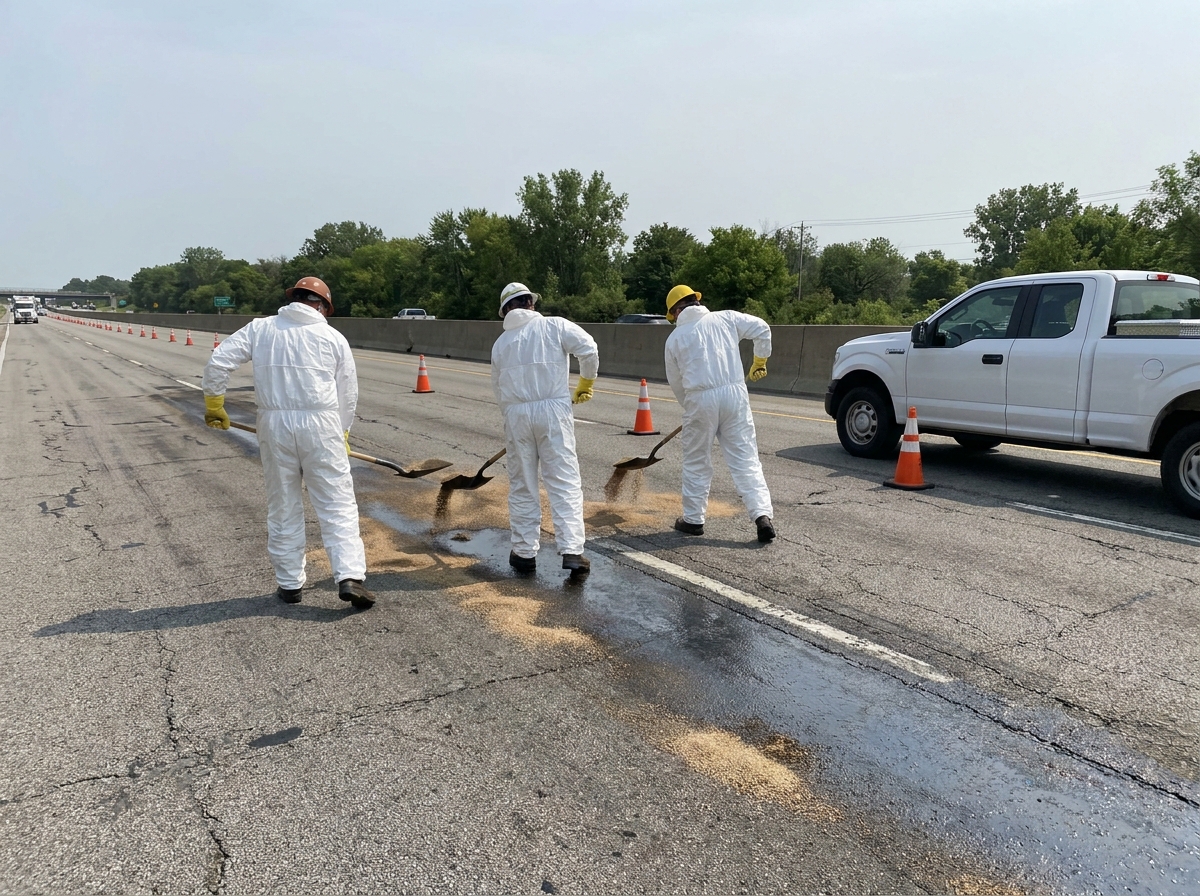
A spill usually brings in state hazmat responders and cleanup crews, and it can widen the list of people hurt. Spilled oil, fuel or chemicals can cause more crashes, sicken people who breathe the fumes and close roads for hours. Whoever caused the crash or the spill may be liable for that added harm.
In the Caddo Parish collision, the Louisiana State Police hazardous materials office was alerted after oil spilled on I-49. That kind of response is common when a truck's fuel tank breaks open or its cargo leaks. Responders work to contain the spill and keep other drivers away.
Here is how a spill can affect a claim:
- Secondary wrecks. If your car slid on spilled oil, the cause may trace back to the first truck collision.
- Exposure injuries. Fumes or skin contact with chemicals can cause harm that shows up later. Tell your doctor exactly what you were near.
- Cargo records. A bill of lading (the paper that lists what a truck is carrying) shows what was on board. It can also point to the shipper or loader.
- Response reports. Hazmat and cleanup reports can show how big the spill was and how long the road stayed dangerous.
If you were stuck near a spill, write down what you saw and smelled. Note how long you were there. Those details can be hard to recall a few weeks later.
Why does truck crash evidence disappear so fast?
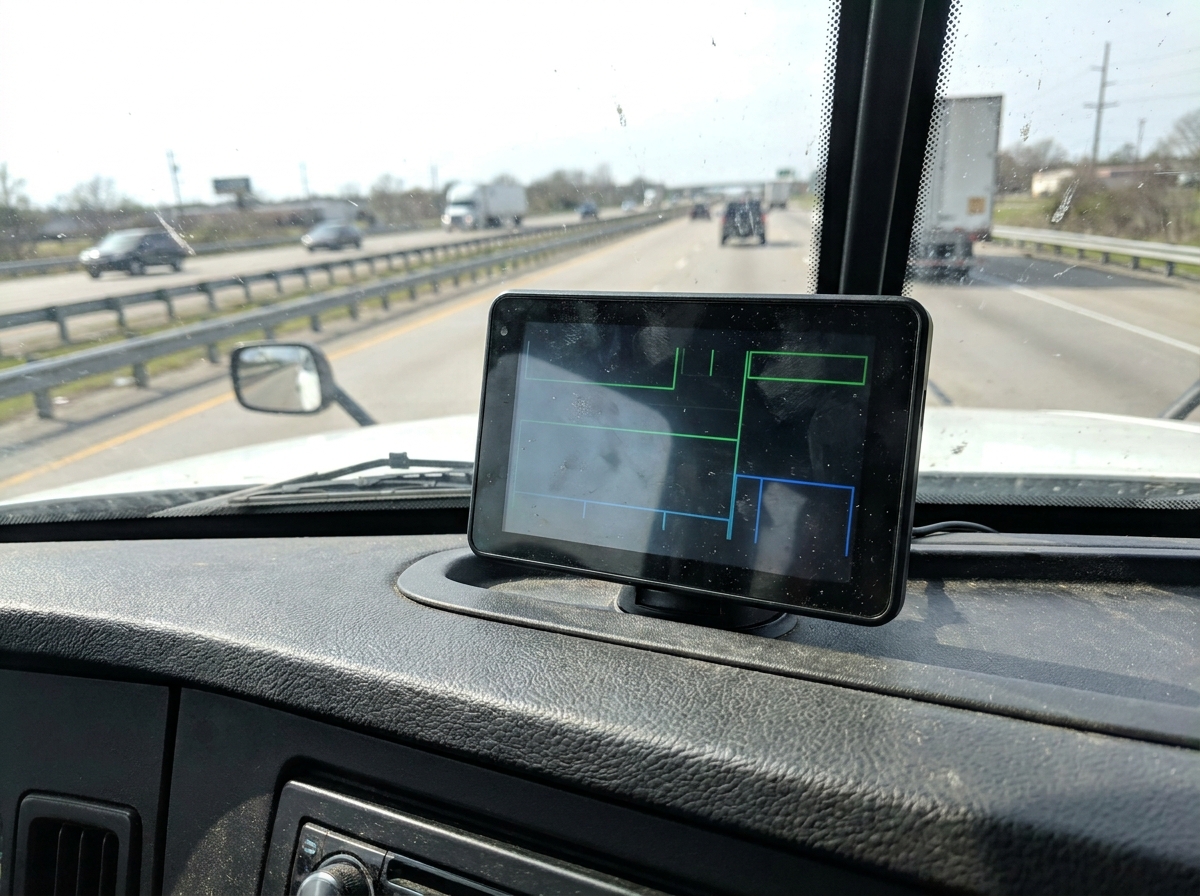
Much of the key evidence sits with the trucking companies, and some of it is only kept for a short time. Electronic data can be recorded over, trucks get repaired or scrapped, and some records only have to be kept for months. Acting early gives the best chance to save it.
These are the records that often matter most:
- ELD data. An electronic logging device (ELD) records a driver's hours behind the wheel. It can show if a driver was over the limit or skipped rest breaks.
- Engine "black box" data. The truck's engine computer may record speed, braking and throttle in the seconds before a crash.
- Dash cam and in-cab video. Many trucks have cameras that loop and record over old footage.
- Inspection and maintenance records. Driver inspection reports and repair bills can show known problems with brakes, tires or lights.
- Driver files. These can show a driver's license history, medical certificate, training and past violations.
- Loading records. Weight tickets and shipping papers can show if a trailer was overloaded or poorly loaded.
- Post-wreck drug and alcohol tests. Federal rules require testing after certain serious wrecks.
When two 18-wheelers crash, all of this doubles. Two companies hold two sets of records, and neither has a reason to hand them over freely. Nearby traffic cameras or business cameras may also have caught the collision, but that footage is often erased quickly.
A common first step is a preservation letter. This is a written request that tells each company to save the evidence. Once a company knows a claim is coming, destroying evidence may hurt its own case in court.
What should you do after two 18-wheelers crash near you?
Get to safety, call 911, get medical care and start saving evidence right away. Then be careful about what you say to the trucking companies' insurers. These steps protect both your health and a possible claim.
- 01. Move to safety if you can. Stay away from spilled fluids, smoke and damaged trailers.
- 02. Call 911. A police report from Louisiana State Police or the local sheriff creates an official record.
- 03. Get checked by a doctor. Do this the same day if you can, even if you feel fine. Some injuries, like whiplash or head injuries, show up later.
- 04. Take photos. Get both trucks, the company names and USDOT numbers on the cab doors, trailer numbers, skid marks, any spill and your car.
- 05. Get witness names. Other drivers saw things you did not.
- 06. Write down what you remember. Note the time, lane, weather and what each truck did.
- 07. Ask how to get the police report. The responding agency can tell you how to request a copy.
- 08. Tell your own insurer. Most policies require prompt notice.
- 09. Get advice before a recorded statement. Talk to a lawyer before speaking on the record with a trucking company's insurer.
Keep every bill, receipt and doctor's note in one folder. Track missed work days too. Small details add up in an auto accident claim.
What mistakes can hurt a truck crash claim?
The biggest mistakes are waiting too long, skipping medical care and saying too much to the other side's insurers. Each one can give an insurer a reason to pay less or deny a claim. Most of them are easy to avoid once you know about them.
- Waiting to see a doctor. A gap in care lets insurers argue you were not really hurt, or were hurt some other way.
- Giving a recorded statement too soon. Your words can be used to shift blame onto you, which matters even more for newer crashes covered by the 51% rule.
- Signing papers early. A quick check may come with a release that ends your claim for good.
- Guessing about fault. Saying "I'm sorry" or "I didn't see them" at the scene can be taken out of context.
- Posting online. Photos or comments on social media can be used against you.
- Fixing your car before photos. Damage to your vehicle helps show how hard the hit was.
- Blaming only one truck. Focusing on one driver can leave out a company, loader or repair shop that may also be liable.
- Missing the deadline. Once prescription runs out, a claim is generally lost.
What are your next steps after a multi-truck wreck in Louisiana?
Focus on healing, keep your records in one place and get advice early while the evidence still exists. A crash between two 18-wheelers is more complex than a typical car wreck. The sooner the right questions get asked, the more evidence there is to work with.
Start by listing what you already have: photos, the police report number, medical records and insurance letters. Then note what you do not have, such as the trucking companies' names or the report itself. That list makes any conversation with an insurer or lawyer more useful.
Chris Corzo Injury Attorneys helps people across Louisiana with truck and car wreck injury claims. A lawyer can review who may be liable, which deadlines apply to your crash date and how to ask the companies to save their records. This article is general information, not legal advice, and every case depends on its own facts.
To talk about your truck crash, contact Chris Corzo Injury Attorneys.
Frequently asked questions
Claims against both trucking companies are often possible when each truck played a part in the crash. Louisiana assigns fault by percentage, so each company may be responsible for its own share of the harm. A claim may also reach the drivers, cargo loaders or repair shops. Who belongs in the claim depends on the evidence, such as ELD data, maintenance records and the police report.
The filing deadline in Louisiana is generally two years for injuries that happened on or after July 1, 2024, under Civil Code Article 3493.1. For injuries before that date, the deadline was generally one year. Some claims, such as those against government agencies, may involve extra steps. Getting advice early helps make sure no deadline is missed and evidence is not lost.
Partial fault generally reduces what you can recover instead of wiping it out, under Civil Code Article 2323. If you were 20% at fault, your recovery may be cut by 20%. For wrecks covered by Act 15 of 2025, generally those on or after January 1, 2026, a person found 51% or more at fault recovers nothing. Which rule applies depends on the facts and the date.
ELD data comes from an electronic logging device, a tool that records a truck driver's hours behind the wheel. Federal rules use it to enforce limits on driving time. After a crash, ELD records can show whether a driver was over the hours limit or skipped breaks. Because trucking companies control this data, asking them early to preserve it may help keep it from being lost.
Injuries from a spill are generally tied back to whoever caused the crash or the spill itself. That may be a driver, a trucking company or a shipper that loaded hazardous cargo poorly. Your own auto insurance, such as medical payments or uninsured motorist coverage, may also help. Medical records that show exposure or a spill-related wreck are important evidence for any claim.
Sources